Tuesday, March 18, 2025

François Duprat: In Memoriam

On March 18, 1978, François Duprat, a tireless activist of the nationalist Idea, number 2 of the Front National and main theorist of revolutionary nationalism, was assassinated, the victim of a car bomb attack.


We have played, I have lost: I demand death


On the night between March 15 and 16 in Paris, the writer Pierre Drieu La Rochelle took his own life.

A purebred Norman, he dedicated his life to the awareness of Europe’s decline and to the virile dream of its redemption. Before his final act, he left a note beside him in which he affirmed his loyalty to the ideal of collaboration and acknowledged the victory of the Resistance, declaring that, having lost, he demanded death.

For his collaborationist activities—more literary than anything else—and for his voluntary withdrawal from politics in 1943, he was not at risk of the death penalty or even a long imprisonment. Yet he preferred to act like an officer who had lost the war and wished to preserve his honor.

In his life, which was relatively short—having ended it at the age of 52—he wrote thirty-five books, many of which were successful. One of them, Le Feu Follet (The Fire Within), would be adapted into a film after the war by Louis Malle in 1963. Other films would later be inspired by his novels, including Une Femme à sa Fenêtre (1976) and La Voix (1992), both directed by Pierre Granier-Deferre, as well as Oslo, August 31st (2012) by Joachim Trier.

Drieu’s central theme

the thread running through Le Feu Follet, was always death. He consistently expressed a drive toward suicide—but a cathartic suicide, aimed at rising from the ruins, never a desperate one. He was a man of taste, of success, and an elegant conqueror of many beautiful women who adored him. His primary subject was not only his own death but the death of civilization itself. Alongside this, he explored the strength required to accept it, as well as the prospect of regeneration. This is why he always sided with the vital forces that could give society a virile jolt.

During the Great War, he was struck by the incompetence of commanders and the greatness of those courageous enough to step up in their place. He attests to this in his memoir La Comédie de Charleroi. Returning from that experience, hoping to shake a decadent society, he immersed himself in rebellious circles: surrealists, communists, and the monarchists of Action Française.

On February 6, 1934

the nationalist right protested in Paris against parliamentary corruption scandals. The Assemblée Nationale (Parliament) fired upon the demonstrators, even using machine guns. Eighteen people were killed, and thousands were injured.

Exactly eleven years later, the writer Robert Brasillach was executed near Paris for collaborating with the Germans. Before his execution, he wrote, “I think of you, the dead of February 6, and I will be with you, eleven years late.” This writing is found in the collection La Mort en Face (Death in the Face), where he also wrote:

“They say that the sun and death cannot be looked at directly. Nevertheless, I have tried. I am no Stoic, and it hurts to be torn from what one loves, but I have tried, so that those who would see me or think of me would not be left with an undignified image.”

Following the bloodbath in front of Parliament, another protest took place on February 11, this time by the communists. There were no deaths. But Drieu La Rochelle became convinced that political parties only served to divide the people and that, if united, they could change everything. He dedicated himself to a new era, based on the strength of a unified people and the dream of something greater.

He even suggested that all ancient ruins be destroyed so that people would no longer rest on past glories. He had already expressed a similar idea in L’Europe contre les patries (Europe Against Nations) in 1931: France itself was outdated.

In 1939, he openly declared himself a fascist

in his novel Gilles, supporting the Parti Populaire Français of Jacques Doriot, a former communist leader turned national-socialist. He wrote for newspapers that supported the Vichy government, including Je Suis Partout and La Nouvelle Revue Française, where he was editor-in-chief.

Over time, he came to believe that not only did political parties divide the people, but that nationalism itself, rather than uniting into a single International, fragmented Europe and made it weak.

In 1943, with a novel set in South America, L’Homme à Cheval (The Man on Horseback), he told the magnificent ending of a leader who dreamed of building a greater and imperial homeland, only to be overwhelmed by the failure of such an ambitious, poetic, and romantic dream.

The following year, in Les Chiens de Paille (The Straw Dogs), he was likely the first to speak of the rise of globalism.

By the summer of 1943, he withdrew from political collaboration, convinced that a true European project was not being built.

He then wrote a poem that, after the war, would become the European neofascist manifesto

We are men of today.
We are alone.
We have no more gods.
We have no more ideas.
We believe neither in Jesus Christ nor in Marx.
It is necessary that immediately,
at once,
in this very moment,
we build the tower
of our despair and our pride.
With the sweat and blood of all classes,
we must construct a homeland
like none ever seen before;
compact like a block of steel,
like a magnet.
All the scattered fragments of Europe
will be drawn to it by love or by force.
And then, before the block of our Europe,
Asia, America, and Africa
will become dust.

On the night between March 15 and 16, he left a final note: “We have played, I have lost: I demand death.”

His adversary Jean-Paul Sartre will acknowledge: “He was sincere, and he proved it!”

After the war, he would become the point of reference for the idea of a New Europe for the revolutionary nationalist movements of Europe

among which the figures of the French Maurice Bardèche, friend and brother-in-law of Robert Brasillach, the Englishman Oswald Mosley, the Italian Filippo Anfuso, later followed by Adriano Romualdi, and the Belgian Jean Thiriart would stand out.

All the university organizations of the radical right would be inspired by his work.
The first book of another notable Norman (born by chance in Paris), Jean Mabire, would be dedicated to him and is the most beautiful work ever written on the subject: Drieu parmi nous (Drieu Among Us), released in the same year, 1963, when Louis Malle brought his existentialist novel to the big screen.
Jean Mabire would embody, for the entire post-war period, the European and Norman spirit as perhaps no one else, writing over a hundred books, both novels and historical essays, and would train at least two generations of young militants.

Eighty years later, the memory of Drieu La Rochelle

has slightly faded. Partly because there is no vitalism, and even less myth, among political forces, and partly because having taken his own life and not being killed by the enemy, one cannot exercise, in remembering him, that subtle and unconscious victimhood which, unfortunately, is very present in commemorations.


Because it is always forgotten that: “Heroes should not be mourned, they should be imitated!”


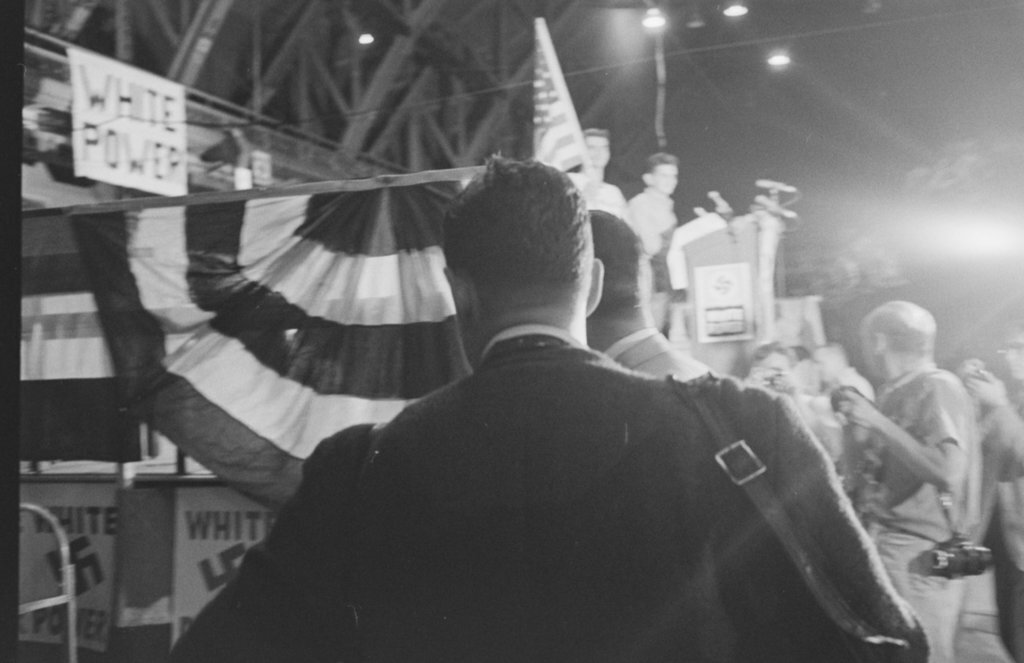
American Nazi Party rally Chicago Coliseum, September 10, 1966


Saturday, March 15, 2025

Self Preservation

”We do not blame nature when she sends a thunder storm and makes us wet: why then do we term the man who inflicts injury immoral? Because in the latter case we assume a voluntary, ruling, free will, and in the former necessity. But this distinction is a delusion. Moreover, even the intentional infliction of injury is not, in all circumstances termed immoral. Thus, we kill a fly intentionally without thinking very much about it, simply because its buzzing about is disagreeable; and we punish a criminal and inflict pain upon him in order to protect ourselves and society. In the first case it is the individual who, for the sake of preserving himself or in order to spare himself pain, does injury with design: in the second case, it is the state. All ethic deems intentional infliction of injury justified by necessity; that is when it is a matter of self preservation. But these two points of view are sufficient to explain all bad acts done by man to men. It is desired to obtain pleasure or avoid pain. In any sense, it is a question, always, of self preservation.”

Friedrich Nietzsche


Provided that the Blood is kept Pure


The White Man died in Stalingrad

"The White man died in Stalingrad. The fall of Stalingrad was the end of Europe. There was a cataclysm. The epicenter was Stalingrad. There, one can say, it was over, truly over... the civilization of the Whites. Because the world is gradually turning into Brazil."

Louis-Ferdinand Céline


The Runes of the SS

“For 5,000 years the Nordic Folk have been using Runic Letters to symbolically express a wish or a sacred thought. One of the oldest symbols is the Swastika, which is the sign of the sacred cycle of the Sun and which therefore may be looked upon as the symbol for the ideology of the Nordic Race. Today it is the symbol of our Third Reich.

The SS Officer Corps wear the Sig Rune, Gibor Rune, Tyr Rune, Fa Rune, and Hagall Rune on their Totenkopf – – Death’s Head Rings. The Man Rune and Yr Rune are used as signs for birth and death on announcements, obituaries, and on headstones. The Ing Rune and Odal Rune are signs for the blood (weddings) and the ground (sign on family estates and farms).

“I award you the Death’s Head Ring of the SS.

It is intended to be:

A symbol of our loyalty to The Leader, of our unwavering obedience to our superiors, and our unshakeable sense of bonding and comradeship.

The Death’s Head is the reminder to always be ready to risk one’s own life for the life of the whole.

The Runes across from the Death’s Head are holy symbols of our past, to which we are once again connected through the philosophy of National Socialism.

Both of the Sig Runes represent the name of our Schutzstaffel — Protective Echelon. The Swastika and Hagall Rune are intended to keep our unshakeable belief in the victory of our philosophy in front of our eyes.

The Ring is encircled by oak leaves, the leaves of the old German tree.

This Ring may not be acquired through purchase, and it may never be allowed to fall into unauthorised hands.

This Ring is to be returned to the Reich Leader Of The SS upon your discharge from the SS or upon your death.

The making of imitations and copies are punishable offences. It is your duty to prevent their occurrence.

Wear this ring with honour!”

H. Himmler.

This is the Death’s Head Ring Citation. The Ring is a symbol of the new SS religion. Upon the death of the wearer the ring is kept at Himmler’s Wewelsburg Castle.”

-The Celebrations in the Life of the SS Family


Friday, March 14, 2025

Brother Nations

“We’re largely supportive of many of the nationalist movements we see in Europe, and believe strongly in the right of our brother nations to pursue their own national sovereignty and self determination. Cultural movements and aspects of political ideals have always made their way back and forth across the Atlantic. While we do our best to source all of our core ideological tenets domestically, that doesn’t stop us from getting artistic, tactical, or organizational inspiration from Europe. The more organized we all are, the more we have to inspire one another to succeed.”

Thomas Rousseau


Thursday, March 13, 2025

Otto Rahn: 18.02.1904 - 13.03.1939


“I believe that I just saw God on this road! He came riding like a knight, beautiful and strong. His blond hair fell around his bronzed face and his bright eyes shone... ‘Peire Vidal, you have met Lucifer, whom you call Lucibel!’”

Otto Rahn - Lucifer's Court 


Christianity judaizing the world